Part of 2026 May 19, 2026 ·
---days
--hrs
--min
--sec
Content Hub People Article
People Mar 27, 2026 · 6 min read

The Capital Moves East: Joachim Enegaard on Investing Where Europe Builds

Most European VC maps still centre on London, Berlin, and Paris. Rockaway Ventures is redrawing them — backing defence tech, industrial AI, and energy founders in Prague, Warsaw, and Tallinn, where the engineering depth is world-class and the valuations haven’t caught up yet.

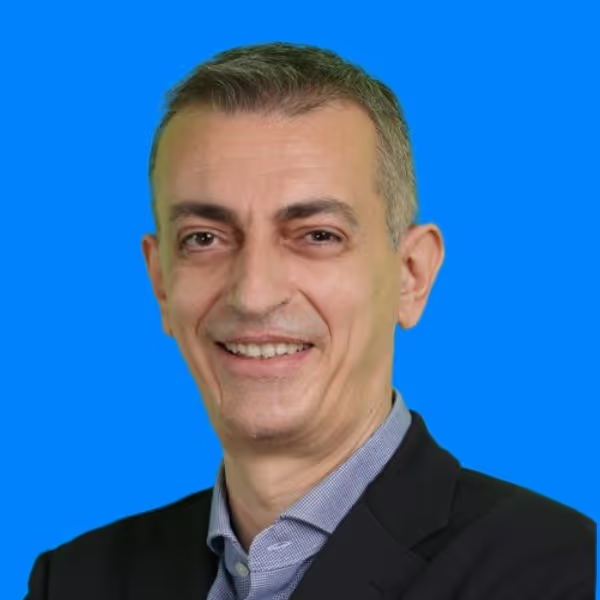
Joachim Enegaard — Investor at Rockaway Ventures and Speaker at Human × AI Conference 2026

There is a map of European venture capital that most investors carry in their heads. London sits at the centre, handling roughly a third of all European VC deployment. Berlin and Paris flank it. Stockholm, Amsterdam, and Munich fill in the northern tier. Everything east of Vienna is marked, implicitly if not literally, as emerging.

Joachim Enegaard thinks this map is about five years out of date. As an investor at Rockaway Ventures — a Prague-based Seed and Series A fund within the Rockaway Capital group — he deploys capital across a geography that the traditional VC map underweights: Central and Eastern Europe, where the technical talent is deep, the founder ambition is high, and the sectors that matter most to European strategic autonomy are being built.

The Thesis

Rockaway Ventures invests in three verticals: defence and dual-use technologies, industrial AI, and energy. These are not trend-chasing categories. They are the sectors where Europe has declared strategic priority — through procurement budgets, through regulation, through industrial policy — and where the gap between declared priority and deployed capital creates the opportunity that Rockaway is designed to fill.

Defence tech is the most obvious example. European defence spending is rising faster than at any point since the Cold War. Governments across the continent are actively seeking dual-use technologies — systems with both civilian and military applications — from European suppliers. But most European defence primes are legacy contractors, and most European VC funds have historically avoided the sector entirely. Rockaway saw this gap early: a structural demand signal from governments, a structural supply shortage from startups, and a structural capital shortage from investors.

Why CEE

The Central and Eastern European startup ecosystem produces a specific kind of founder that the Western European VC circuit has been slow to recognise. These are not consumer app builders optimising for virality. They are systems engineers, cryptographers, aerospace researchers, and industrial automation specialists — technical founders building in sectors where the product is hard, the sales cycle is long, and the defensibility is structural rather than cosmetic.

Prague, where Rockaway is headquartered, sits at the centre of a technical talent pool that extends from Tallinn to Sofia. The Czech Republic alone produces more computer science graduates per capita than any Western European country. Poland’s deep tech ecosystem is growing faster than Germany’s. Romania’s cybersecurity talent pipeline supplies companies across the continent. And the cost structure — for salaries, for office space, for early-stage operations — gives CEE founders a runway advantage that their Berlin and London counterparts do not have.

Enegaard’s move from Copenhagen to Prague was itself a signal. He left BlackWood, a Danish VC fund where he had built a track record sourcing deals and leading due diligence, because Rockaway offered something that Scandinavian venture capital could not: direct access to the founders building the infrastructure layer of European sovereignty, at valuations that reflect the geography rather than the opportunity.

Why Vienna

The Human × AI Conference is positioned at the geographic and thematic intersection of Enegaard’s investment thesis. Vienna is the Western European city closest to CEE — culturally, logistically, and increasingly in terms of capital flow. The conference’s focus on European AI as a question of strategic capability, not just commercial opportunity, maps directly onto Rockaway’s portfolio.

Enegaard brings to Vienna the investor’s perspective on a question that the conference’s founder and policy audiences are asking from different angles: where will the next generation of European deep tech actually be built? His answer — informed by a portfolio that spans defence, industrial AI, and energy across the CEE region — may surprise attendees whose mental map of European innovation still centres on the Western capitals.

Implications

  • For founders in CEE: Rockaway’s thesis validates what many already know: the technical depth exists, the market opportunity is real, and the capital is beginning to follow. Founders building in defence, industrial AI, or energy should be positioning for investors who understand the CEE advantage — not apologising for their geography.
  • For Western European investors: The valuation arbitrage between CEE and Western European deep tech is real and closing. Rockaway’s presence at the conference is a signal: the funds that move early into CEE deep tech will capture the structural premium. The funds that wait will pay Western European prices for the same talent.
  • For conference attendees: Expect an investor’s map of European deep tech that looks nothing like the consensus view — with Prague, not Berlin, at the centre, and defence tech, not SaaS, as the category that defines the next European venture cycle.

Joachim Enegaard joins Human × AI on May 19, 2026, in Vienna.

Created by People. Powered by AI. Enabled by Cities.

One day to shape
Europe’s AI future

Early bird tickets available. Secure your place at the most important AI convergence event in Central Europe.