Radar · 5 min read
What 270 European Leaders Actually Said About Digital Sovereignty
Wire's 2025 survey of 270+ European leaders reveals deep conviction about encryption and open source — alongside deep pessimism about execution timelines. The data is useful. The framing requires scrutiny.
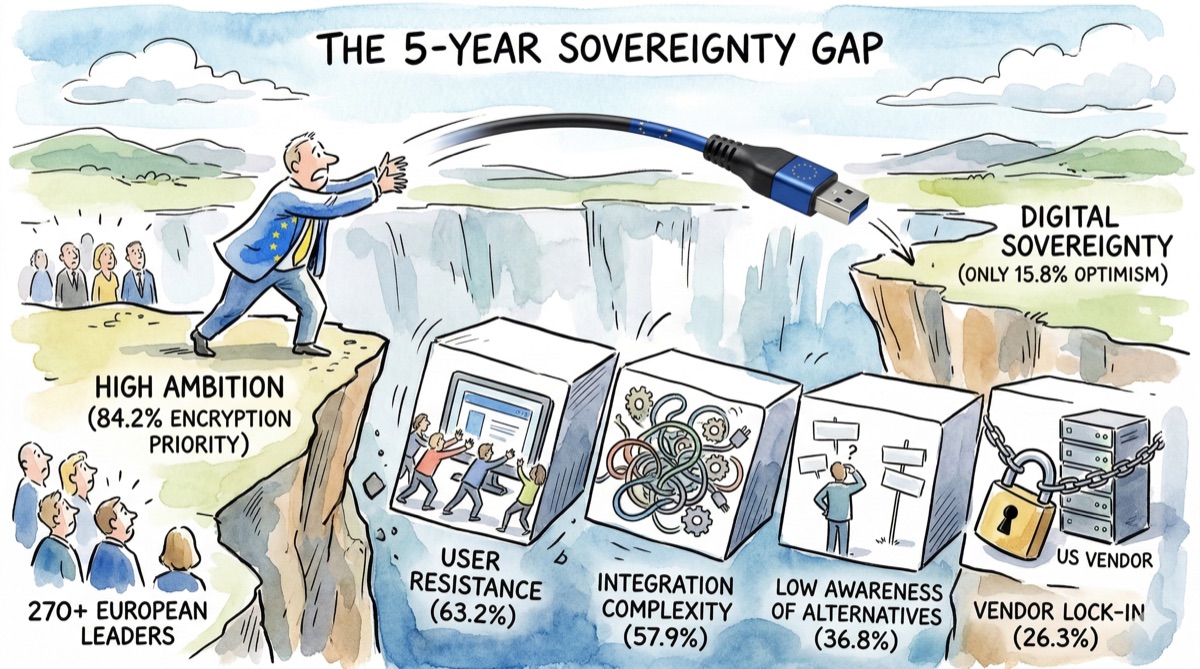
Wire published its State of Digital Sovereignty in Europe 2025 survey last autumn: 270+ European technology, policy, and security leaders, polled on encryption, open-source adoption, vendor dependency, and sovereignty timelines. The headline finding — 84.2% identified end-to-end encryption as a top priority — lands predictably from a company that sells encrypted communications. The more instructive number sits further down the page: only 15.8% of respondents believe European digital sovereignty is achievable within five years.
That gap between conviction and confidence is where the useful analysis begins.
What Does the Wire 2025 Digital Sovereignty Survey Measure?
The survey captures the stated priorities and perceived barriers of European technology, policy, and security leaders regarding digital sovereignty — the capacity of European institutions and organisations to control their own data, infrastructure, and communications without extraterritorial dependency. Wire, the Switzerland-based encrypted communications provider, commissioned and published the research.
The respondent pool spans public and private sector leadership. The questions cover encryption requirements, open-source readiness, vendor dependency, regulatory effectiveness, and adoption barriers. The data is directional rather than representative — 270 respondents cannot stand for a continent — but the patterns are consistent enough to merit analysis, particularly where they align with or contradict broader policy signals.
Three Data Points That Survive the Vendor Filter
Vendor-commissioned research requires a simple filter: which findings serve the commissioner's commercial interests, and which exist independently of them? Three numbers clear that threshold.
- 63.2% rate open-source software as "critical" to sovereignty strategies. This finding has independent corroboration. The Cyber Resilience Act, NIS2's transparency provisions, and the European Commission's own open-source strategy all point in the same direction. The survey confirms a policy consensus that already exists in legislative text.
- Only 15.8% are optimistic about achieving sovereignty within five years. This is the most valuable finding precisely because it contradicts the report's own implied narrative. Wire has commercial incentives to project progress. The respondents — the practitioners closest to implementation — do not share that confidence.
- 47.4% cite reducing U.S. vendor dependency as a strategic imperative. This is lower than institutional rhetoric would suggest. Fewer than half of European technology leaders treat vendor dependency as a strategic priority, despite the CLOUD Act's well-documented implications. The gap between policy discourse and operational priority-setting is worth monitoring.
The Four Blockers Tell a Familiar Story
The survey identifies four primary barriers to sovereign technology adoption. Their ranking describes an organisational change management problem, not a technology problem.
| Barrier | Respondents |
|---|---|
| User resistance to switching from familiar platforms | 63.2% |
| Integration complexity with existing IT ecosystems | 57.9% |
| Lack of awareness of viable European alternatives | 36.8% |
| Vendor lock-in through contracts and proprietary formats | 26.3% |
These are the same four blockers that appeared in enterprise cloud migration surveys half a decade ago. The pattern is structural: sovereignty transitions fail at the adoption layer, not the infrastructure layer. European alternatives exist — Wire, Tuta, Pydio, Nextcloud, Schwarz Digits — but the switching costs are organisational, not technical.
The European Parliament's recent decision to ban AI features on lawmakers' devices illustrates the institutional version of this dynamic. When confronted with a sovereignty constraint, the response was to disable functionality rather than migrate to a sovereign alternative. User resistance topped the survey for a reason.
Why Regulations Alone Cannot Deliver Sovereignty
NIS2, GDPR, DORA, and the CLOUD Act create legal frameworks for data control. But compliance with these regulations does not equal operational sovereignty. The survey data confirms this gap: 47.4% of respondents said regulations "somewhat help," while 26.3% felt they may actually hinder progress through compliance overhead.
Forrester research cited in the report sharpens the point: 84% of decision-makers consider sovereignty critical when selecting vendors, yet confidence in their own compliance remains low. The mechanism is familiar — regulation creates the obligation to act but not the capacity to act. Procurement officers can require sovereignty criteria in their evaluation frameworks. Without institutional switching capacity, the criteria produce documentation rather than operational change.
This mirrors the pattern identified in the EU AI Act compliance analysis: regulatory deadlines arrive before organisational readiness. The sovereignty domain shows the same lag between legislative ambition and implementation bandwidth.
Implications
- For procurement officers: The survey data supports embedding sovereignty criteria in vendor evaluation. But criteria without switching capacity produce compliance documentation, not operational change. Pilot deployments in low-risk communications channels may offer a pragmatic entry point.
- For European alternative providers: The 63.2% user resistance finding is the product problem, not the policy problem. Sovereignty sells to CISOs. Usability sells to everyone else. The AI Factory model — structured access pathways reducing friction — may offer a template for the communications layer.
- For policymakers: The 15.8% optimism figure is the number that demands attention. If practitioners closest to implementation do not believe sovereignty is achievable within five years, policy timelines need recalibration — or the support mechanisms need redesigning.
- For conference attendees: Digital sovereignty recurs across Human × AI themes — infrastructure, governance, institutional capacity. The gap between regulatory frameworks and operational deployment is where cross-disciplinary dialogue adds decision-value.
Frequently Asked Questions
What are the biggest barriers to digital sovereignty in Europe?
According to Wire's 2025 survey of 270+ European leaders, the four primary barriers are user resistance to switching platforms (63.2%), integration complexity with existing IT ecosystems (57.9%), lack of awareness of European alternatives (36.8%), and vendor lock-in through contracts and proprietary formats (26.3%). These are predominantly organisational challenges, not technology gaps.
Is Europe making progress on reducing U.S. tech vendor dependency?
Progress is mixed. While 47.4% of surveyed leaders cite reducing U.S. vendor dependency as a strategic imperative and regulations like NIS2 and GDPR create compliance frameworks, only 15.8% believe European digital sovereignty is achievable within five years. The CLOUD Act remains a structural vulnerability — U.S. authorities can compel data access regardless of EU hosting location.
Which European alternatives to U.S. cloud and communication tools exist?
Functioning European alternatives include Wire (encrypted communications, deployed in German federal ministries), Tuta (encrypted email with 10 million users), Pydio (self-hosted file sharing for regulated industries), Nextcloud (collaboration platform), and Schwarz Digits (European technology stack including partnerships with Aleph Alpha and StackIT). Their collective market share remains marginal against Microsoft, Google, and AWS, but institutional deployments — particularly in the German public sector — demonstrate operational viability.
Last updated: March 7, 2026
Keep the conversation going
Back to the Content Hub