
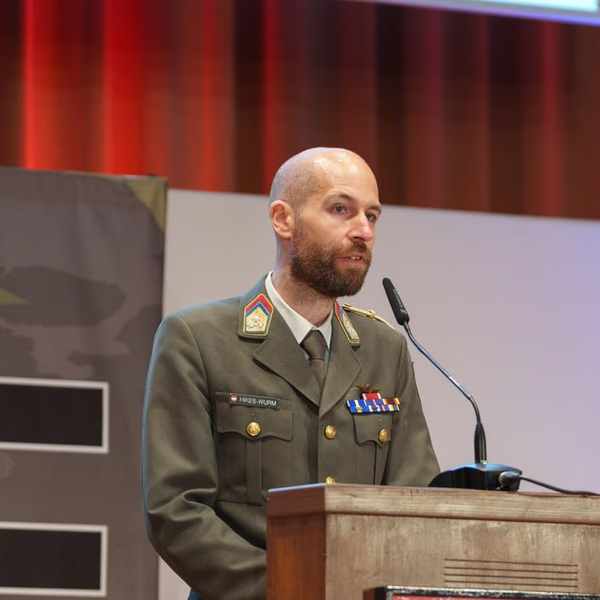
On the morning of May 6, 2025, Colonel Daniel Hikes-Wurm walked onto the stage at the Theresan Military Academy in Wiener Neustadt and delivered the opening keynote of that year's Theresan Military Academic Forum. The room was full of officers, scholars, and policy advisors. The thematic frame for the next two days was autonomous warfare. The Forum's own published account credits the keynote with "setting the thematic tone for the event."
That sentence, read closely, is an unusually loaded one. The thematic tone for a senior European military academic forum on autonomous warfare is now being set by an Austrian defence-policy voice — not a US Department of Defense official, not a Brussels institution, not a NATO programme office. The European debate on what autonomous warfare actually is, and what doctrine it requires, has begun to organise around its own continental voices. Hikes-Wurm is one of the more visible of them.
He serves as Senior Advisor for Defence Policy at the Austrian Federal Ministry of Defence, in the Department of Defence Policy and Strategy under the Directorate General for Defence Policy. His official focus, in his own published phrasing for the Journal of Information Warfare, is "the security and defence policy implications of technological developments, such as Artificial Intelligence and emerging and disruptive technologies, Cyber Defence policy, and hybrid threats." Each of those four phrases is doing real work. Together they describe the part of European defence policy that has to keep up with civilian technology cycles and currently does not.
That is also why he joins Human × AI on May 19 in Vienna. The conference's question is not whether Europe will produce frontier AI; it is whether Europe will be able to absorb frontier AI fast enough to remain strategically autonomous. The doctrine layer of that question lives where Hikes-Wurm works.
Two Clocks That Have Stopped Agreeing
European defence has historically run on a long clock. Procurement cycles measured in decades. Doctrine revisions measured in administrations. Force-structure decisions taken once and inherited for a generation. The clock matched the technology base on which it was built: industrial, mechanical, mostly legible.
The civilian technology clock has stopped agreeing with that one. A frontier AI capability that did not exist eighteen months ago is now running in production at every Tier 1 European company that pays attention. The hybrid-threat surface that was a research seminar five years ago is now a daily operational reality at member-state level. The sensors, autonomy stacks, and software-defined platforms that defence procurement still treats as exotic are commodity components in commercial supply chains.
The defence-policy work, then, is not about choosing between the two clocks. It is about engineering a way for them to interoperate without either pretending to be the other. That is what the published policy literature — including Hikes-Wurm's own contributions to the Austrian Ministry of Defence's strategic publications and to TRUPPENDIENST — keeps returning to. Doctrine cannot move at frontier-tech speed. Frontier tech cannot wait for doctrine. The policy question is what mechanism allows the slower clock to acquire and govern the faster one without breaking either.
The Sovereignty Argument, Stated Plainly
Hikes-Wurm's most explicit statement of his own thesis is the title of his recent paper in the Journal of Information Warfare: Digital and Technological Sovereignty of the European Union: Strategic Necessity to Survive in the Global Competition?! The punctuation is deliberate. The argument is not a slogan; it is a question whose answer carries a price tag.
The plain version of the argument runs roughly like this. A Europe that runs its critical workloads on infrastructure it does not control, with models trained on regimes whose interests are not aligned with its own, in supply chains it cannot inspect, is not strategically autonomous. The cloud provider can be friendly today. The model weights can be available today. The chip supply can be reliable today. None of that is a doctrine. None of it is a guarantee. Strategic autonomy is the condition in which all of these substrates can be reasoned about, accounted for, and replaced if necessary. It is not a sentiment.
The cyber-defence and hybrid-threat dimensions of his portfolio sharpen the same point. Hybrid operations are designed to operate below the threshold that triggers a hard military response, on infrastructure layers where the line between civilian and military authority is genuinely blurred. The defender's posture in that environment is not a more powerful weapon system; it is a higher-quality understanding of what is happening, in real time, across networks the defender does not own. That understanding is, increasingly, an AI capability. Whose AI capability matters.
The Public Voice
One of the more notable features of Hikes-Wurm's work is how publicly he conducts it for a senior policy advisor. The talks are listed on the official record. In April 2024, he spoke at GISEC in Dubai on fortifying national and EU cyber defence through regional collaboration and technological innovation. He has represented the Austrian Chief of the General Staff at the 9th Istanbul Security Conference hosted by TASAM. The keynote at TMAF 2025 followed a year later. The publication record runs to nine entries on the Bundesheer scientific publications portal.
This matters because European defence policy has a credibility deficit in the public AI conversation that mirrors its talent deficit in the operational layer. The institutions that should be visible voices on AI in defence are largely invisible to the founders, investors, and engineers building the underlying systems. Speakers like Hikes-Wurm — accessible, on-record, willing to engage with the civilian technology side rather than treat it as a different country — are the connective tissue that lets European defence-tech actually function as a category.
Why This Belongs in the Vienna Conversation
Most of the agenda at Human × AI is framed around founders and investors building or funding the next layer of European AI. The Sovereign Capital panel, the Stack panel, the keynotes on cybersecurity and quantum security all live on the commercial side of that line. The doctrine side is structurally underrepresented in the AI-conference circuit, not because it is irrelevant but because it does not speak the language of fundraising rounds and product launches.
Adding a senior defence-policy voice into a room of founders and capital allocators is one of the small structural decisions that determines whether a conference produces real conversation or rehearsed positioning. The room benefits from the friction. So does the policy side: the questions Hikes-Wurm thinks about for a living are easier to answer when the people building the technology stack are sitting in front of him rather than briefed second-hand.
Back to the Lectern
Back at the Theresan Military Academy, the keynote that set the thematic tone for TMAF 2025 ended, the room broke for the first panel, and the work continued the way policy work continues: slowly, in writing, in the long meetings that do not make headlines. By the standards of the slower of the two clocks, that is exactly how it is supposed to look. By the standards of the faster clock, it is not yet fast enough. Closing the gap between the two is the project. Hikes-Wurm joins the Vienna conversation at the point in the calendar where the project is most clearly framed.
Colonel Daniel Hikes-Wurm joins Human × AI on May 19, 2026, in Vienna.