
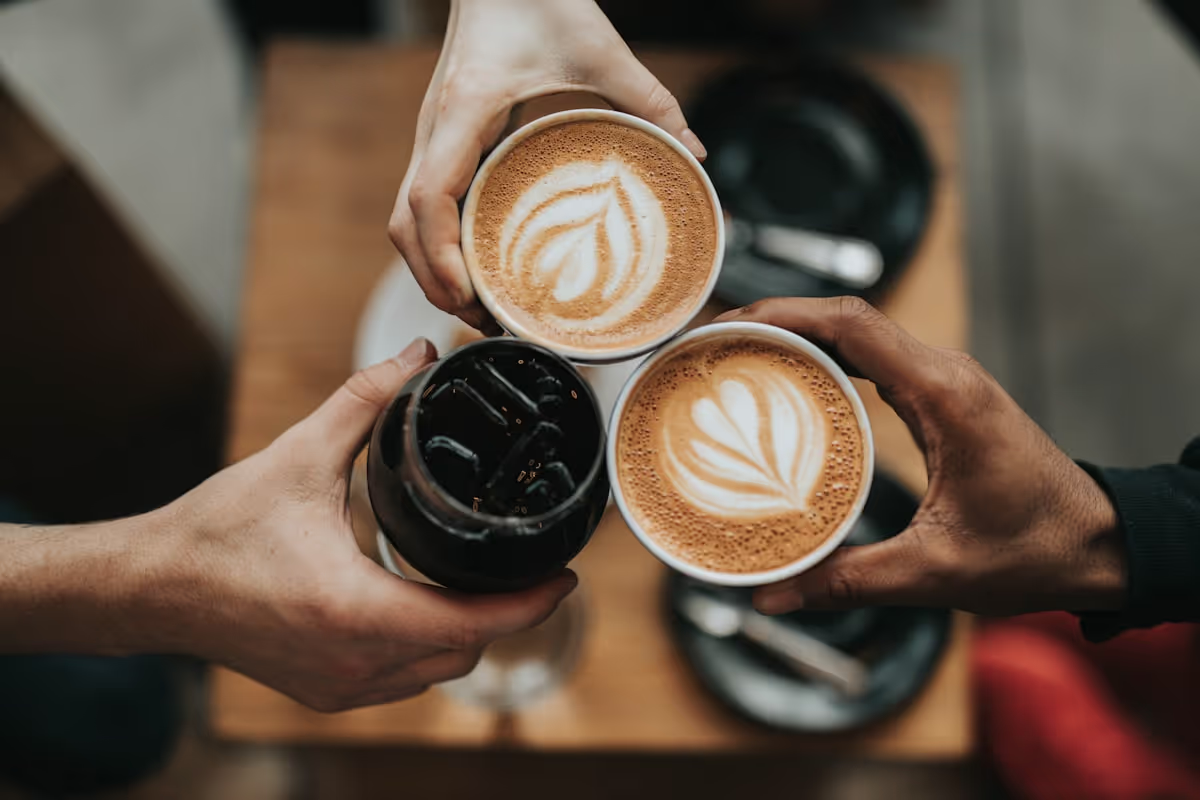
Consider the most consequential business decisions you have ever been part of. Not the board vote. Not the Slack thread. The real decision — the one where someone changed their mind, or you changed yours. There is a reasonable probability it happened with a coffee cup in someone’s hand.
This is not sentimentality. It is an observable pattern in how humans negotiate trust. And in a year when every conference on the planet is talking about automating human interaction, it is worth examining the one interaction protocol that has stubbornly resisted automation for four hundred years.
The Viennese Specification
Vienna did not invent coffee. But Vienna wrote the specification for how coffee structures human conversation. The Kaffeehaus — UNESCO-listed since 2011 — is not a place where you buy a drink and leave. It is a place where you sit, think, talk, argue, read, and occasionally have an idea that changes your trajectory. Freud did it. Trotsky did it. The logical positivists of the Vienna Circle did it. The drink was incidental. The infrastructure for unhurried human presence was the point.
The Kaffeehaus protocol has a specific architecture: a marble table, a glass of water that nobody asked for, a waiter who does not rush you, and the implicit social contract that the person across from you has nowhere more important to be. Compare this with the modern conference networking break: fifteen minutes, a queue, a paper cup, a name badge scanned at speed, a LinkedIn connection that neither party will ever activate. The Viennese version is better engineered. It just doesn’t scale.
Or does it?
The Cambio Hypothesis
Cambio Caffè operates from Florianigasse in Vienna’s eighth district — a few streets from the Rathaus, deep in the kind of neighbourhood where startup founders and doctoral students share pavement café tables without either party finding it unusual. The company’s production is rooted in Mortegliano del Friuli, in the Udine province of northern Italy — the belt of land where Italian coffee tradition runs deepest. Their baristas are not staff. They are specialists: trained in latte art, flavour profiles, and the less quantifiable discipline of making people feel at ease.
When Cambio brings its barista catering service to Human × AI on May 19, they will be deploying this expertise at scale. But the premise is not simply better coffee at a conference. The premise is that the quality of the coffee changes the quality of the conversation. This sounds like marketing. It is also, inconveniently for the sceptic, supported by the evidence.
The Biochemistry of Trust
Caffeine is a psychoactive stimulant. This much is obvious. What is less obvious is the behavioural context in which it operates. A warm beverage in hand may increase perceived warmth toward strangers — a hypothesis explored in social psychology research, though the evidence remains debated. The ritual of sharing coffee activates patterns of reciprocity and social bonding that predate civilisation. The pause required to drink something hot enforces conversational pacing that cold beverages and energy drinks do not.
None of this is magic. All of it is architecture. The Kaffeehaus understood, long before behavioural economics had a name, that the physical environment of a conversation shapes the cognitive environment of the people in it. A well-pulled espresso is not a luxury. It is load-bearing infrastructure for the kind of interaction that conferences exist to produce.
What Machines Cannot Brew
Here is the tension at the centre of a conference about human-AI convergence: the most valuable moments at any conference are the ones that resist algorithmic optimisation. The serendipitous encounter. The hallway conversation that runs thirty minutes past the session it was supposed to precede. The moment when someone you have just met says something that reframes a problem you have been thinking about for months.
AI can optimise for information transfer. It can match attendees by interest graph. It can summarise a keynote in real time. What it cannot do is replicate the specific neurochemical state that humans enter when they are physically present, unhurried, and holding something warm. That state is where trust forms. And trust — not information, not connections, not deal flow — is the actual output of a good conference.
Cambio Caffè is, in this framing, not a catering partner. It is infrastructure for the conference’s core function.
The May 19 Deployment
At Human × AI, Cambio’s baristas will be stationed throughout the venue at the Hofstallungen in the MuseumsQuartier. Italian-roasted specialty coffee, prepared by professionals who understand that the thirty seconds between order and cup is itself a micro-interaction — a moment of human contact in a day otherwise structured around stages and screens.
Vienna is, for one day, running a live experiment: two hundred people discussing the future of human-AI collaboration, fuelled by the oldest human collaboration technology that still works exactly as designed. The AI can take the notes. The coffee will handle the rest.
Why This Matters
- For conference attendees: Cambio Caffè’s specialty barista stations will be available throughout the day at Human × AI. Skip the queue-and-go instinct. Take the espresso. Find a marble surface. The best conversation of the day will find you.
- For the AI-curious: The Kaffeehaus is a useful lens for understanding what should and should not be automated. Some protocols are analog for a reason. Coffee is the original proof of concept.
- For Vienna: The city’s coffee infrastructure is not a tourism asset. It is a competitive advantage in the business of building trust between strangers — precisely the business that conferences are in. Cambio Caffè brings that advantage from Florianigasse to the MuseumsQuartier on May 19.
Cambio Caffè is the official coffee partner of Human × AI Conference 2026. cambiocaffe.com