
Here is the conference lunch as the industry currently understands it: a room adjacent to the main hall, buffet tables arranged in a line, disposable plates stacked at one end, a sign reading “Vegetarian” placed next to a dish that is, technically, vegetarian. Attendees fill their plates, find a seat, check their phones, eat in twelve minutes, and return to the programme. The lunch has been optimised for throughput. It has been optimised for nothing else.
Eventhinkplay looked at this arrangement and did something unusual. They asked: what if the lunch were not logistics? What if it were content?
The Construction
The first design decision was architectural. Synthesis Play Noon does not happen in a separate room. It happens inside the event hall at MUMOK — the Museum of Modern Art in Vienna’s MuseumsQuartier, where the Human × AI Conference takes place. The lunch is not adjacent to the conference. It is embedded within it. The same space that hosts morning keynotes transforms, at midday, into an exhibition you can eat.
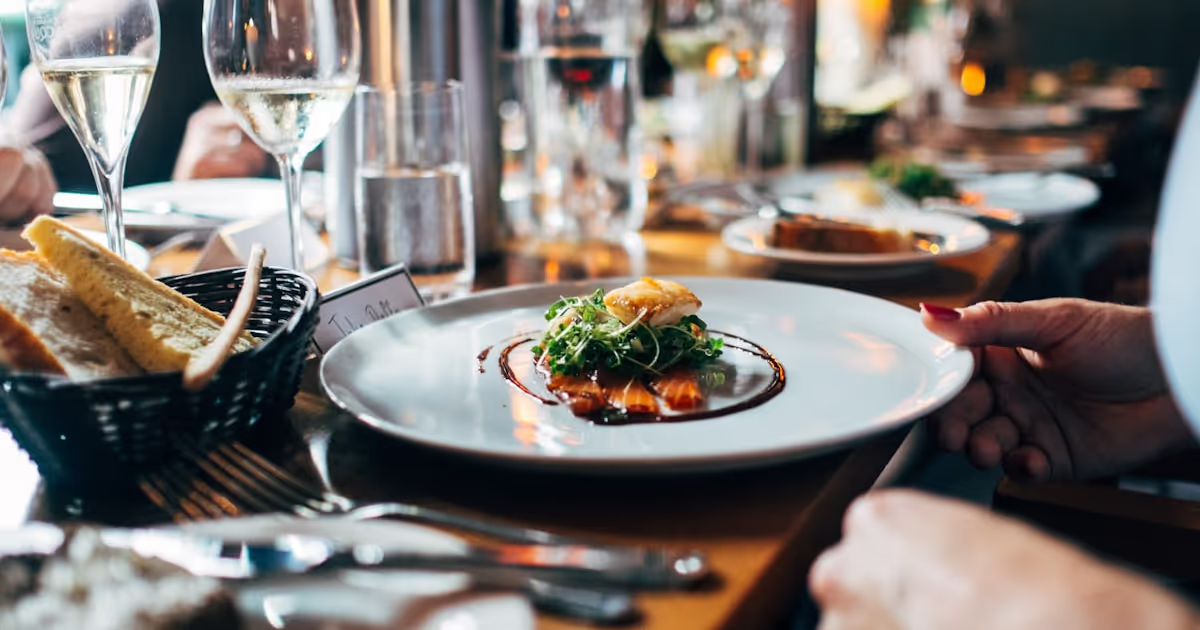
This is not a metaphor. The food stations are installations. Each one is designed around a theme — social dynamics, environmental sustainability, technological mediation, physical health — and each one creates a specific kind of interaction between the participant and the material. You do not queue for a plate. You move through an environment. The environment happens to be edible.
If this sounds like something that belongs in a contemporary art programme rather than a conference schedule, that is precisely the point. MUMOK is not a convention centre. It is a museum. The lunch should behave accordingly.
The Food, Reformatted
Eventhinkplay uses a vocabulary for food that most catering companies would find bewildering: reformatted, reutilised, merged, re-envisioned. The language is deliberate. It signals that the ingredients have been through a design process, not merely a kitchen. A carrot is not served because it is in season. It is served because it occupies a specific position in a narrative about soil, supply chains, and the distance between a field in Lower Austria and a plate in the seventh district.
The sustainability dimension is structural, not performative. This is not a conference lunch with a “green menu” option. Every element — the sourcing, the preparation, the serving format, the waste management — is designed as a closed loop. The food is the argument. If you want to understand why sustainable systems matter, you do not need a panel discussion. You need lunch.
The Curators Are Nineteen
Perhaps the most structurally interesting decision: the participants are navigated through the experience by a team of young and very young food curators. Not waiters. Not caterers. Curators — in the museum sense of the word. They know what each installation means. They can explain the provenance of the ingredients, the design logic of the presentation, and the conversational dynamics the station is designed to produce.
There is something genuinely subversive about placing a nineteen-year-old food curator in front of a fifty-year-old enterprise CTO and having them explain why the way a beetroot is cut matters. The power dynamic inverts. The executive becomes the student. The student becomes the authority. The conversation that follows is, almost by definition, more interesting than anything that would have occurred over a buffet.
Why This Belongs Here
A conference about the relationship between humans and artificial intelligence has, at its core, a question about what remains irreducibly human when machines become capable of most cognitive tasks. The standard list includes creativity, empathy, moral reasoning. It rarely includes eating together.
This is an oversight. Shared meals are among the oldest human technologies for building trust, negotiating status, and creating social bonds. Every significant human institution — religion, diplomacy, family, commerce — has a table at its centre. The anthropological literature is unambiguous: breaking bread with someone is a commitment device. It signals that you are willing to be vulnerable (you are chewing), present (your phone is in your pocket), and unhurried (you cannot speed-eat with dignity).
AI cannot do any of this. Not because the technology is immature, but because the value of the act is located in the physical co-presence of human bodies sharing a biological necessity. A language model can write a dinner invitation. It cannot sit across from you, notice that you have not touched your food, and ask if everything is all right.
Synthesis Play Noon takes this anthropological reality and turns it into a design brief. The lunch is not a break from the conference. It is the conference’s argument made physical: that the most important human capabilities are embodied, relational, and impossible to automate — and that the correct response to AI is not anxiety but a deeper investment in the things that only humans can do. Like eating together. Like playing with your food. Like allowing a teenager to teach you something you did not know you needed to learn.
What to Expect
- Format: An exhibition-installation curated into the main event hall at MUMOK — not a separate catering area. The lunch is part of the programme, not apart from it.
- Experience: Food stations designed as interactive installations, each exploring a theme at the intersection of sustainability, health, technology, and social dynamics. Guided by young food curators.
- Design principle: Every element — ingredients, presentation, waste management — is part of a closed-loop sustainable system. The food is reformatted, reutilised, merged, and re-envisioned.
- Why it matters: In a conference about human × AI, the lunch demonstrates what no algorithm can replicate: the irreducible human experience of sharing a meal, face to face, in a room full of people who came to think together.
Synthesis Play Noon is part of the Human × AI Conference on May 19, 2026, at MUMOK Vienna. Curated by Eventhinkplay.