AI Policy · 5 min read
Power Before Code: Why Energy Infrastructure Is the Non-Negotiable Foundation of Sovereign AI
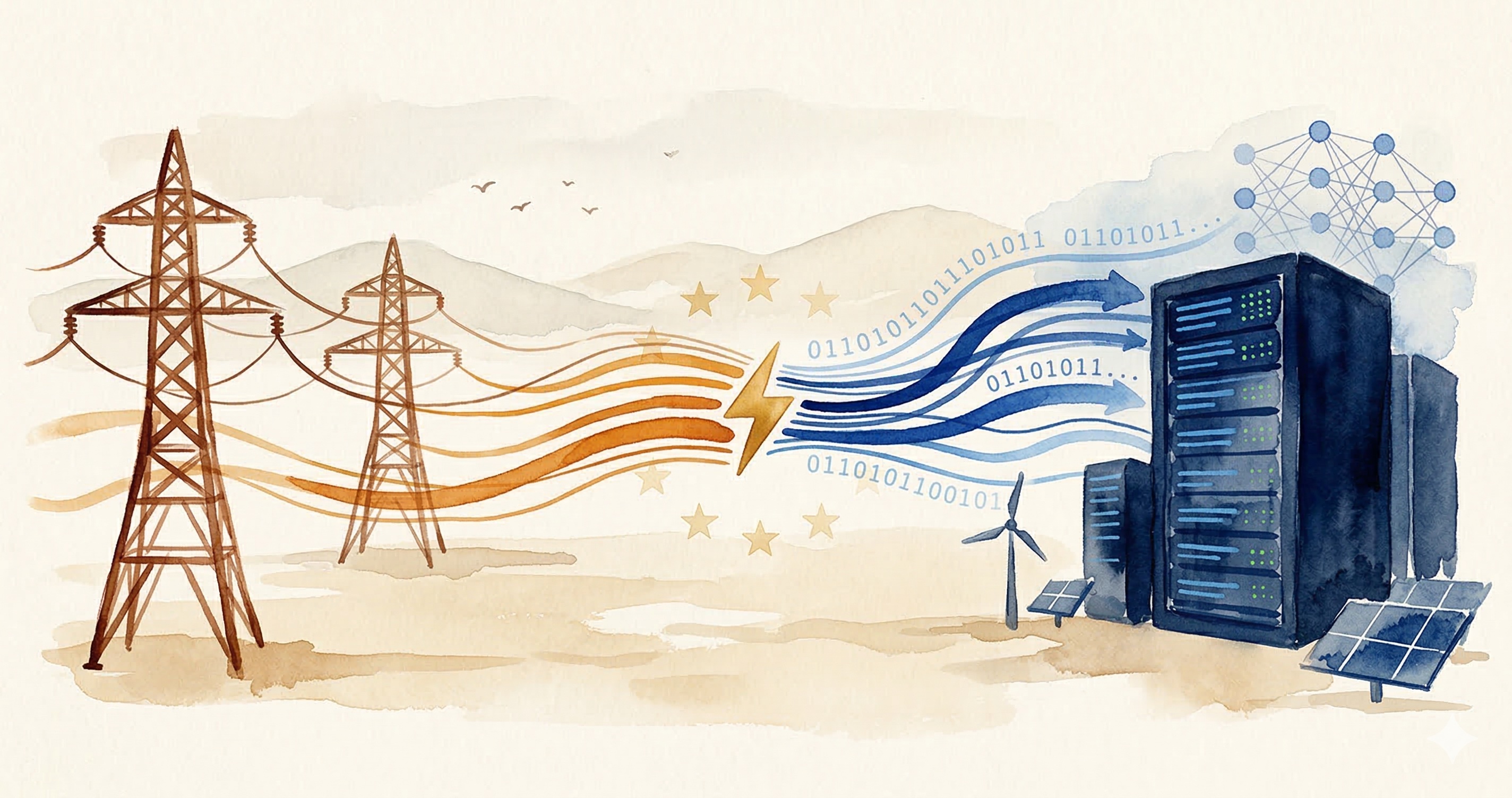
Europe's AI ambitions run on electricity. With data centre demand projected to reach 150 TWh by 2030 and grid bottlenecks stalling projects from Dublin to Frankfurt, the real constraint on sovereignty is not compute — it is power.
The Constraint Nobody Wants to Talk About
Somewhere in Dublin right now, a data centre sits half-built. Land secured. Permits issued. Servers on order. EUR 5.8 billion worth of Irish data centre projects share the same fate — stranded, not by regulation or capital, but by something far more elemental.
No grid connection. No power. No path to getting it.
Ireland imposed a moratorium on new data centre grid connections in 2022. Connection lead times in congested European markets now stretch to a decade. And Dublin is not an outlier — Amsterdam and Frankfurt face the same wall. Europe's most mature data centre hubs are running out of the one resource that AI cannot optimise its way around.
Electricity.
That bottleneck is about to collide with something much larger. But before we get there — a number worth sitting with.
The Scale of What's Coming
EU data centres consumed approximately 70 TWh of electricity in 2024. Roughly 3% of the bloc's total demand. The IEA's base case projects that figure climbing to 150 TWh by 2030. Higher estimates, factoring in the current AI training arms race, push toward 280 TWh. A fourfold increase in six years.
Now look at the hardware driving that curve. NVIDIA's B200 GPUs draw over 1,000 watts each. A single GB200 NVL72 rack — the building block of frontier AI training — pulls 140 kW and demands liquid cooling. A 20,000-GPU cluster needs roughly 28 MW from the grid. The EU's proposed AI Gigafactories, each targeting at least 100,000 GPU-equivalents, will require power allocations measured in hundreds of megawatts per site.
Brussels has committed serious money. The InvestAI initiative earmarks EUR 20 billion for up to five such facilities. The proposed Cloud and AI Development Act aims to triple EU data centre processing capacity within five to seven years.
Here is the structural mismatch at the heart of all this: building a data centre takes one to two years. Expanding the grid to feed it takes considerably longer. Europe is writing cheques its grid cannot yet cash.
So who can?
Three Models, Three Geographies
France grasps the asymmetry better than anyone. At the February 2025 AI Action Summit in Paris, EDF made an offer that turned heads: four plots of land adjacent to nuclear plants, totalling 3 GW of available power capacity, with two more sites to tender by 2026. The logic is clean — co-locate compute next to baseload generation, eliminate transmission bottlenecks, access cooling water. France's 56 operational reactors supply roughly 70% of the country's electricity. Low-carbon. Dispatchable. Available around the clock.
The private sector responded with EUR 109 billion in AI investment commitments. That is not a policy paper. That is capital following kilowatts.
Germany tells a different story. It completed its nuclear phase-out in April 2023 and now imposes Europe's strictest data centre requirements: 100% renewable electricity by January 2027, mandatory waste heat reuse, PUE caps. Defensible climate goals — and, in the short term, competitive friction. German industrial electricity prices sit well above French equivalents. The viable site envelope narrows.
Then there are the Nordics. Iceland runs on 100% renewables. Norway generates over 90% from hydropower. Sweden combines hydro, wind, and nuclear. Power prices run 40–60% below Western European averages, cold climates slash cooling costs, and waste heat feeds district heating networks. Microsoft's $3.2 billion commitment to Swedish AI infrastructure — paired with 1,000 MW of new clean energy — follows this calculus precisely.
Three models. Three bets on different energy architectures. But each confirms the same underlying truth: the geography of AI is being drawn by the geography of power.
Which brings us to a country that rarely makes the AI headlines — and probably should.
Austria's Quiet Wager
Vienna captures over 74% of Austria's data centre market, projected to reach USD 1.1 billion by 2030. Microsoft launched Azure Austria in July 2025 — three availability zones, 100% renewable. Google has secured building approval for a facility near Linz. The hyperscalers are arriving.
But the more consequential move is happening below the surface, in the grid itself.
EVN, the Lower Austrian energy utility serving over three million customers across 14 countries, is investing EUR 250 million annually in grid modernisation. Total capital expenditure scales to EUR 900 million per year through 2030 — spanning networks, wind generation, heating, and charging infrastructure. These are not speculative allocations. They are steel in the ground.
One acquisition tells the story in miniature. When EVN bought Vienna-based CyberGRID, it gained access to the cyberNOC flexibility management platform — a system that pools distributed solar, wind, and battery storage into a virtual power plant. By July 2023, the platform had aggregated 100 MW of flexibility reserves, actively trading on the Austrian Power Grid.
This is the layer that makes everything else possible. AI sovereignty requires not only generation capacity but grid intelligence — the ability to balance intermittent renewables, absorb demand spikes, and allocate power dynamically across competing loads. EVN's trajectory, from conventional utility to data-driven flexibility operator, maps the transition that European energy companies must make if compute infrastructure is to scale on this continent.
What This Means
The conversation about European AI sovereignty typically centres on chips, models, and regulation. It is incomplete. Upstream of all of it — upstream of every GPU cluster, every foundation model, every sovereign cloud initiative — sits a question about electrons.
- Grid expansion is the critical path. Without accelerated permitting and investment in transmission and distribution, EU targets for AI compute capacity remain aspirational. The proposed CADA legislation must address grid timelines explicitly — not as an afterthought, but as the binding constraint it is.
- Energy mix is redrawing AI geography. France's nuclear fleet and the Nordics' renewables are pulling investment away from grid-constrained Western European hubs. Secondary markets — Austria, Spain, Poland — stand to gain, but only if they invest in power infrastructure now, before the window closes.
- Flexibility matters as much as capacity. Virtual power plants, demand response, smart grid orchestration — the kind of infrastructure EVN is building — are not peripheral. They are prerequisites for integrating high-density AI workloads without destabilising supply for everyone else.
- Sovereignty has a kilowatt dimension. Europe's ability to train and deploy AI on its own terms depends, before anything else, on whether it can power the machines. Every month of grid delay is a month of dependency extended.
Keep the conversation going
Back to the Content Hub

